

In today’s world, text messages often play a major role in our personal relationships. Couples discuss finances through text, parents coordinate schedules, and family members communicate important information through their phones every day. When a family law dispute arises, those conversations can become more than just messages on a screen. They can potentially become evidence.
A common question people ask during divorce, child custody disputes, and other family law matters is whether text messages can be used as evidence in court. The short answer is yes.
However, there is more to it than simply taking a screenshot and handing it to a judge.
Why Text Messages Matter in Family Law Cases
Text messages can provide a clear record of conversations, agreements, threats, admissions, and other communications that may be relevant to a family law case. Unlike a verbal conversation, which often comes down to one person’s word against another’s, text messages create a written history that can be reviewed later and may help clarify what was actually said.
Depending on the circumstances, text messages may be used to help establish facts related to:
- Child custody disputes
- Parenting time disagreements
- Domestic violence allegations
- Divorce proceedings
- Financial disputes
- Violations of court orders
- Harassment or intimidation claims
Because family law cases often involve conflicting accounts of events, written communications can sometimes provide valuable context and evidence.
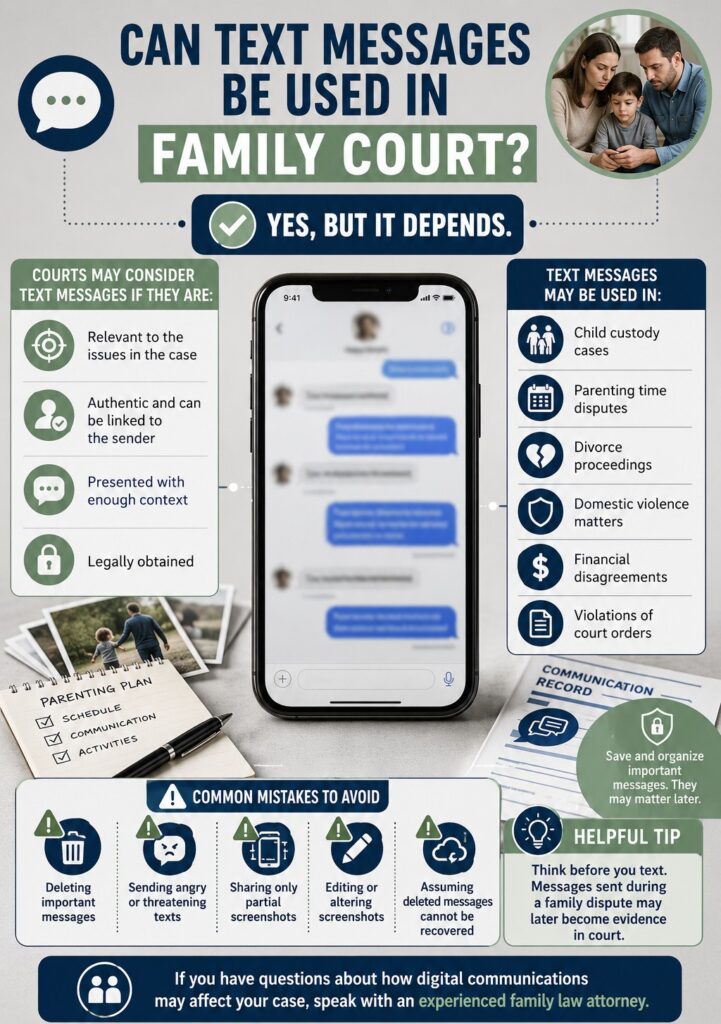
What Makes a Text Message Admissible?
Not every text message automatically becomes evidence in court.
Like other forms of evidence, text messages generally must meet certain legal requirements before a judge will consider them.
One important consideration is authenticity. Before a court relies on a text message as evidence, it needs to be reasonably confident that the message is genuine and was actually sent by the person it is attributed to.
This may involve showing:
- Testimony from a party involved in the exchange
- The sender’s phone number
- Contact information associated with the message
- Context within the conversation
- Additional evidence confirming the identity of the sender
Courts understand that digital communications can potentially be altered, fabricated, or taken out of context. Because of this, proving authenticity is an important step.
Are Screenshots Enough?
Many people assume that a screenshot is all they need to prove what was said in a text conversation. While screenshots can sometimes be used as evidence, they aren’t the best option. A single screenshot that appears damaging can sometimes look very different when the entire conversation is reviewed and additional context is discovered.
- In recent years, programs such as iMazing have created the ability for parties to back up, download, and export chats as a singular .pdf with date and time stamps, saving the client time and money and making trial preparation more efficient for the attorney.
Text Messages and Child Custody Cases
Text messages do often play a role in custody and parenting disputes.
For example, messages may help show:
- A parent’s willingness to co-parent with the other parent
- Consistent involvement in a child’s life
- Attempts to interfere with parenting time
- Attempts to undermine or denigrate the other parent to the child or to others involved in the child’s life
- Failure to follow court orders
- Communication regarding the child’s health, education, or activities
When making custody decisions, courts must focus on what is in the child’s best interests. Because of that, text messages may be considered if they provide insight into a parent’s behavior, judgment, involvement, or ability to communicate effectively about the child’s needs.
Can Deleted Text Messages Be Recovered?
Many people wonder whether deleting a text message makes it disappear forever. Not necessarily. Depending on the circumstances, deleted messages may sometimes be retrievable through backups, subpoenas to service providers, forensic examinations, or other sources of digital evidence.
The ability to recover deleted messages varies significantly from case to case and depends on the device, messaging platform, service provider, how much time has passed, and other factors.
It’s also important to understand that intentionally destroying relevant evidence during a legal dispute can create serious problems. Courts generally expect parties to preserve evidence that may be relevant to ongoing litigation.
What About Messages from Social Media Apps?
Modern communication extends far beyond traditional text messaging. Messages sent through social media may also potentially be used as evidence in family court, including:
- Facebook Messenger
- Snapchat
- Signal
- Other messaging applications
The same general guidelines apply. The messages must be relevant, authentic, and legally admissible under applicable rules of evidence.
Can Private Messages Be Used Against You?
If a message is relevant to a family law dispute and can be properly authenticated, then yes, it may potentially be presented as evidence even if the sender expected the conversation to remain private.
This is one reason attorneys typically advise clients to be cautious when communicating during a divorce or custody dispute. A good rule of thumb is to communicate with others in a cordial way and understand that all communications may end up being read aloud in front of a court reporter in litigation.
Common Mistakes People Make with Text Messages
When family law disputes arise, people sometimes make decisions regarding text messages that ultimately hurt their case.
Some common mistakes include:
- Deleting Messages/Assuming Messages Cannot Be Retrieved
Deleting potentially relevant messages can create legal complications and may raise questions about what was removed. In some cases, deleted messages can be recovered and cause serious credibility issues for the party who deleted them.
- Cherry-Picking Conversations/Altering Conversations
Sharing only selected parts of a conversation can backfire if the full context tells a different story. Modifying screenshots or attempting to fabricate evidence can severely damage your case and may have significant legal consequences.
Remember that a conversation is TWO people, and both may have a copy of the conversation.
- Sending Emotional or Aggressive Messages
Highly emotional texts can become evidence that reflects poorly on a party’s judgment, especially in custody disputes. Judges want to see that the parties can set aside grievances to effectively co-parent and keep their children’s best interests at the forefront of conversations—even when there is emotional turmoil in the current family dynamics.
How a Family Law Attorney Can Help
Digital evidence has become increasingly important in modern family law cases.
An experienced family law attorney can help evaluate whether text messages may support your position or create vulnerability for your case, identify potential evidentiary issues, and help ensure that important communications are properly preserved.
What seems like an insignificant text message today may become an important piece of evidence later, and what seems like a pivotal text message may ultimately not be as decisive as expected.
A skilled attorney can provide guidance on how to properly communicate with a difficult party in a way that preserves your peace, and your case.
Final Thoughts
Text messages can absolutely be used in family court, and in many cases, they play a significant role. Whether the issue involves child custody, parenting time, divorce, or allegations of misconduct, digital communications often provide valuable insight into the facts of a case.
That said, not every text message will be admissible, and context matters just as much as the words themselves.
If you are involved in a family law matter and believe text messages may be relevant, speaking with an experienced family law attorney can help you understand your options, provide guidance on best practices when communicating through writing with others, and ensure that important evidence is handled appropriately.